Progressives cannot afford to ignore the political consequences of working-class dealignment from the Democratic Party. While the magnitude of this shift varies depending on how the working class is defined, the underlying trajectory is consistent and alarming. Class dealignment is real and increasingly multiracial, especially since the 2024 election when non-white men shifted decisively toward the Republican Party.
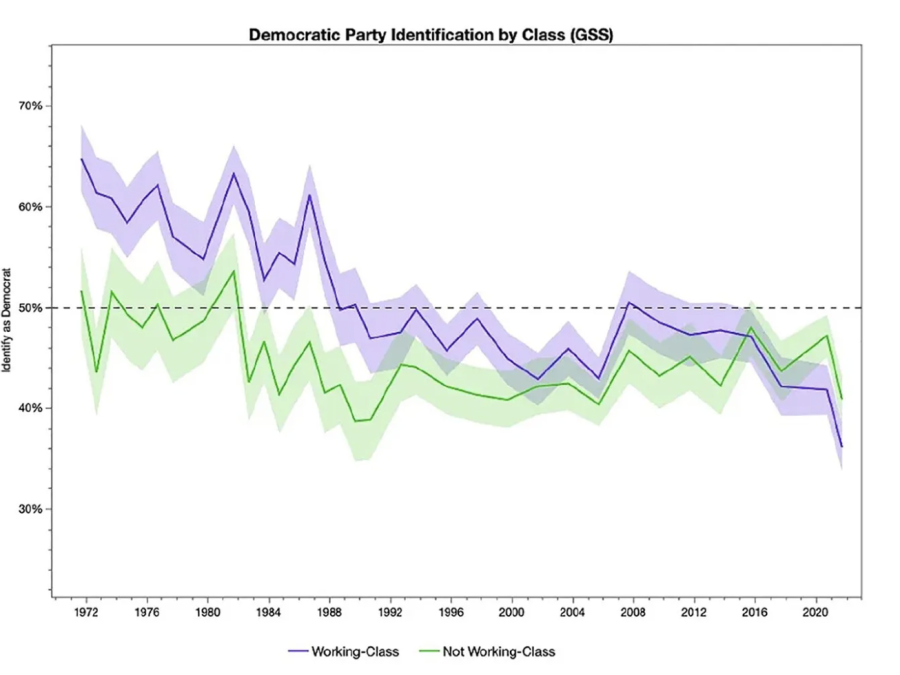
Working-class dealignment matters for several reasons. First, it makes it much harder for progressives to win national elections. The structure of the US political system — particularly the Electoral College and the Senate — gives disproportionate power to states with large working-class electorates. Without winning back significant numbers of these voters, progressives are unlikely to secure durable governing majorities. In 2020, working-class voters (defined as those without a four-year college degree) made up the majority of the electorate in all five key swing states — and working-class whites alone constituted outright majorities in Michigan, Pennsylvania, and Wisconsin. According to my analysis of Cooperative Election Study data, Joe Biden’s gains among working-class voters in Arizona and Georgia from 2016 to 2020 were 2.3 and 8.5 times larger, respectively, than his overall margin of victory in those states. Similarly, American National Election Study (ANES) data show that 72 percent of battleground state voters who switched parties between 2016 and 2020 were noncollege graduates. Without holding or expanding their current share of the working-class vote, Democrats’ odds of winning national majorities remain slim.
But the stakes go beyond electoral math. As political commentator Andrew Levison has argued, ceding the traditional…
Auteur: Jared Abbott
